
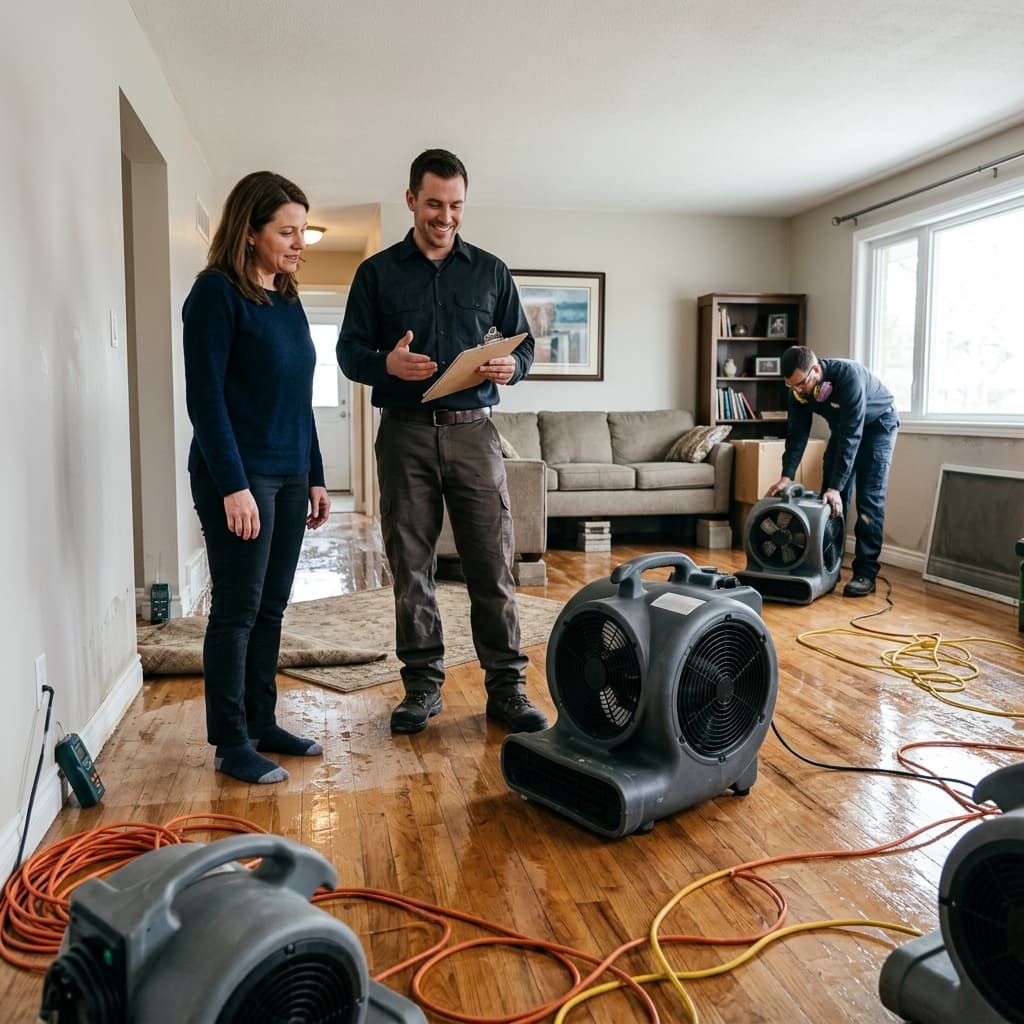
Cost is a scope question, not a flat rate
Homeowners in Ashburn, Leesburg, Sterling, and the rest of Northern Virginia often ask what water damage restoration costs before anyone has seen the house. A responsible answer starts with the conditions that change the work, not with a dollar figure. This article does not give prices. Prime Solutions LLC has no single rate that fits a supply-line leak in one bathroom and a sewage backup in a finished basement. The useful comparison is which facts move the scope up or down.
Category of water: how contaminated it is
ANSI/IICRC S500 is the reference standard for professional water damage restoration. The IICRC describes it as the procedures and precautions for water damage in residential, commercial, and institutional buildings. Category is the contamination classification. Public summaries of the standard describe Category 1 as sanitary water from a supply line, a sink or tub overflow, or an appliance that failed on the supply side. Category 2 water has significant contamination and can include toilet overflows without sewage, dishwasher or washing-machine discharge, and similar losses that are no longer sanitary. Category 3 water is grossly contaminated. The IICRC's 2026 position statement on the current S500 edition says Category 3 water can contain pathogenic, toxigenic, or other harmful agents, and gives examples that include sewage, wasteline backflows from beyond the trap, flooding from seawater, and rising water from rivers or streams. The same statement says weather water is not automatically Category 3. Contamination, not the fact that rain was involved, is the test. Category 2 can become Category 3 as time and temperature allow contaminants to increase. A higher category usually means more protective controls, more material removal, and more disposal planning. That is a cost driver even though this page will not turn it into a fee.
Class of water: how large the drying load is
Class is separate from category. The IICRC uses class as the estimated evaporation load when humidity control or restorative drying starts. It looks at the amount of wet surface and the porosity of what is still in the room. Published quick references that summarize ANSI/IICRC S500 describe four classes. Class 1 is the least absorption and evaporation load, where wet porous materials represent less than about 5 percent of the combined floor, wall, and ceiling area, and low-evaporation materials have taken on little moisture. Class 2 is a significant load, with wet porous materials around 5 to 40 percent of that combined area. Class 3 is the greatest load, above about 40 percent. Class 4 is deeply held or bound water in low-evaporation materials or assemblies, such as plaster, wood, concrete, masonry, or multi-layer floors. Class 4 drying may take special methods, more time, or a larger vapor-pressure difference. Removing unrestorable wet pad or drywall before drying starts can also change the class, because the wet surface area left in the room has changed. Equipment count and days on site follow that load. Days are not a price, but they are one reason two estimates should not match if one loss is a damp closet and the other is a saturated ceiling, wall, and floor.
Materials, assemblies, and access
Carpet and pad, sheet vinyl, hardwood, plaster, and cabinet bases do not dry the same way. Pad under carpet often holds water after the carpet face looks better. Hardwood and plaster can fall into the Class 4 description above when they are saturated. A townhouse party wall or a finished basement in Ashburn can hide migration that a single wet floor does not show. Contents that must be moved, a room with limited electrical capacity for equipment, and an occupied home that cannot isolate a drying chamber all add labor. None of those items has a published price on this website. They belong on a written scope after moisture readings.
Time is a multiplier
Water that is extracted the day it is found wets fewer materials than water that sat through a weekend. The service pages on this site already note that standing water affects drywall and flooring quickly and that clean water left in place can become more contaminated over roughly two to three days under industry classification guidance. EPA guidance cited on those pages also says mold growth can begin within 24 to 48 hours when materials stay wet. Delay does not create a surcharge table here. It changes how much must be removed instead of dried, and it is one reason mitigation should not wait on a claim decision.
Mitigation and reconstruction are priced as different work
Mitigation is source control, extraction, drying, and documentation. Reconstruction is the repair that follows: drywall, insulation, flooring, trim, paint, and sometimes cabinets. A carrier often wants those scopes separated. If a proposal mixes them without photos, moisture notes, and a list of removed materials, the owner cannot see which part is stabilization and which part is rebuild. Prime Solutions LLC's Ashburn mitigation hub describes the first phase. The water damage restoration hub describes the broader recovery.
What to ask for instead of a verbal number
Ask for the assumed category and class, the rooms included, which materials are being dried in place, which materials are being removed, how moisture will be checked, and what is excluded until demolition opens a wall. Ask whether reconstruction is in the same document or later. Ask how sewage or outdoor floodwater would change the plan. Those questions do more for a Northern Virginia homeowner than a round number given over the phone. Call (703) 832-2773 to start that review. If the next question is whether a Virginia homeowners policy pays the work, use the insurance guide linked from this article. Coverage is a carrier decision.
Frequently asked questions
Why is there no price list on this page?
Two losses with the same street address can need different work. Category of water, class of drying, materials, and how long the water sat all change the scope. A number without an inspection would be a guess. Call (703) 832-2773 to describe the loss and schedule a documented review.
What is a water damage category?
Under ANSI/IICRC S500, category describes contamination. Category 1 comes from a sanitary source. Category 2 has significant contamination. Category 3 is grossly contaminated, which can include sewage and some contaminated weather water. Time and temperature can make a Category 2 loss more contaminated.
What is a class of water intrusion?
Class describes the evaporation load when drying starts. It is based on how much porous surface is wet and whether water is bound in low-evaporation materials. Classes run from Class 1, the smallest load, through Class 4, deeply held water in materials such as plaster, wood, concrete, or complex assemblies.
Does reconstruction use the same scope as mitigation?
No. Mitigation extracts water, dries the structure, and records what was affected. Reconstruction replaces or repairs materials after that record exists. Carriers often review those phases separately. Combining them in one undocumented number makes the file harder to follow.
Do Ashburn and Loudoun homes cost more for a special reason?
Location alone is not a price. Finished basements, townhouse party walls, and hardwood over subfloors, which are common in Northern Virginia, change which materials get wet and how they are dried. Those are scope items, not a regional surcharge published on this site.
Will insurance remove the cost?
Insurance may review a sudden accidental water loss and may not review flood, seepage, or a backup that the policy excludes. Any deductible and limit come from the policy. See the Virginia coverage guide on this site and confirm details with your carrier.
Sources
Related pages
Related guides
Need help with property damage?
Prime Solutions LLC reviews active water, fire, mold, and cleanup requests across Northern Virginia, DC, and Maryland.
+1 (703) 832-2773