
Service BaseAshburn, VA & DMV Region
Contact Mailoffice@psolutionservices.com
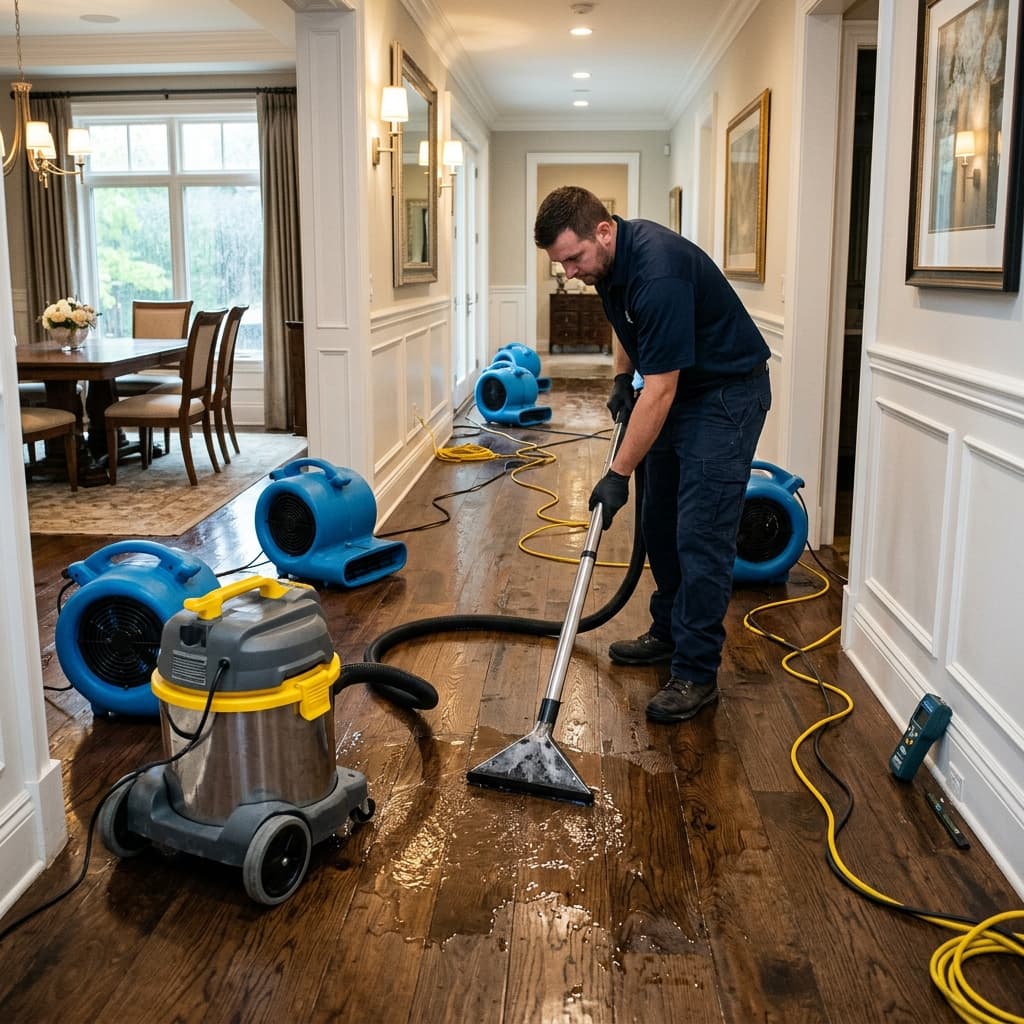
Water damage mitigation is the first controlled response after a leak, overflow, or basement intrusion. It is not the same job as water damage restoration. Mitigation limits how far water moves and creates the record used later for drying goals and repair planning. Restoration is the broader path that can include that stabilization plus cleanup and the return of rooms to use.
At Prime Solutions LLC, we understand the stress that comes with property damage. Our restoration specialists are trained to handle Water Damage Mitigation with care, documentation, and practical recovery planning for your home or business.
Mitigation stabilizes the property. The practical steps are source control, extraction, moisture mapping, drying, and notes about which materials were affected. Water damage restoration is the wider recovery. It can include mitigation and then the cleanup and repairs that make the room usable again, such as drywall, flooring, trim, and paint. Mixing those scopes too early makes it harder to see why a material was removed. Prime Solutions LLC keeps the mitigation record separate from the later repair conversation so the owner and the adjuster can follow the same timeline.
Ashburn and the rest of Loudoun County have a mix of townhouses, newer single-family homes, and finished basements. A failed washing-machine line, a water-heater release, a sump problem during a storm, or a slow leak under a sink can all start as a small wet area and then move under flooring or into a party wall. The amount of work depends on where the water came from, how long it sat, which materials it reached, and whether it is clean supply water or water that has picked up contamination. Those are scope questions. They are not a price list, and this page does not quote a dollar amount.
ANSI/IICRC S500 is the water-damage standard Prime Solutions LLC uses as a reference, not as a claim that a person holds a particular credential. The standard separates category, which describes contamination, from class, which describes the evaporation load at the start of drying. Category 1 is water from a sanitary source. Category 2 has significant contamination and can pose a health risk. Category 3 is grossly contaminated and can include sewage, wasteline backflow, and some weather-related water that is contaminated. Published guidance based on the standard also notes that time and temperature can move a Category 2 loss toward Category 3. Class 1 through Class 4 then describe how much porous material is wet and whether water is held in low-evaporation materials such as plaster, wood, concrete, or built-up assemblies. That classification is one reason two wet rooms are not the same mitigation job.
Step 1 is safety and source control. If it is safe, the water supply is shut off and people stay out of wet areas near outlets or panels. Step 2 is documentation before cleanup changes the scene: photos of the source, the rooms, and the visible water line. Step 3 is extraction of standing water. Step 4 is moisture checks with meters, and thermal imaging when it helps find wet spots that the surface hides. Step 5 is drying with air movers and dehumidifiers, adjusted as readings change. Step 6 is selective removal when carpet pad, wet drywall, or insulation cannot be restored in place, especially after contaminated water. Step 7 is a closeout note of readings, equipment, and materials removed so repair planning can start from a stable structure. Drying is not finished because a floor looks dry.
Homeowners policies often treat a sudden accidental discharge from plumbing or an appliance differently from flood, surface water, groundwater seepage, and sewer or drain backup. In Virginia, the State Corporation Commission Bureau of Insurance tells consumers that flood, surface water, and surge losses are generally outside a standard homeowners policy, and that insurers must offer sewer or drain backup coverage as an option that can cost extra. A mitigation file can show the source, the rooms, the materials, and the steps taken. It cannot promise payment, a deductible, or a coverage decision. Those belong to the carrier and the policy. Read the companion guide on Virginia water-damage coverage before assuming a loss is included.
Start the conversation when water is on floors, when drywall or cabinetry is wicking, when a basement finish is wet, or when water ran and was later shut off but the materials stayed damp. Waiting until an adjuster visit to remove standing water lets moisture move farther into the assembly. Emergency dry-out and the claim can proceed on parallel tracks: document the loss, tell the carrier you are opening a claim if you choose to, and begin stabilization. If the water is sewage or came in from outside over the ground, do not treat it like a clean supply-line leak.
Prime Solutions LLC is based at 42785 Generation Dr, Ste 516, Ashburn, VA 20147, and takes water-damage mitigation requests across Loudoun County and nearby Northern Virginia communities. The city pages linked below include Ashburn, Leesburg, Sterling, Purcellville, Reston, Herndon, Fairfax, Chantilly, Vienna, and Arlington. The same team can connect mitigation to water damage restoration when rooms need repair after drying, and to mold remediation if growth is already present or the materials stayed wet. Call (703) 832-2773 to describe the source, the address, and whether water is still running.
Call (703) 832-2773 if water is on floors or in a basement, if a pipe or appliance line failed, if a storm or sump problem wet finished rooms, or if an area was wet and has not been dried with moisture readings. Also call before repairs are installed over damp materials. If sewage is involved, stay out of the room and do not run the HVAC to air it out.
Public references: IICRC S500 standard page; IICRC position statement on water category and weather.
It is the stabilization phase after a water loss: make the area safer, extract water, dry the structure, and document affected materials. Repairs such as new drywall or flooring come after that record is in place. Prime Solutions LLC provides this work for Ashburn and the surrounding Loudoun County area.
Mitigation stops additional damage and records what got wet. Restoration is the broader recovery and can include mitigation plus cleanup and the work that returns rooms to use. A loss may need only drying, or it may need a repair scope after materials are removed.
Sometimes, when the cause is a sudden accidental release that the policy treats as a covered peril. Flood, surface water, groundwater seepage, and sewer backup are often reviewed under different terms or optional coverage. Prime Solutions LLC can document the loss. The carrier decides coverage. No outcome is guaranteed.
If it is safe, shut off the water, keep people and pets out of standing water, and avoid electrical hazards. Photograph the source and the wet rooms before you move items. Do not place wet carpet back down or close up walls. Save a failed supply line if you can do that safely.
ANSI/IICRC S500 uses category to describe contamination and class to describe how large the evaporation load is. Clean water on a small area is a different project from sewage in a finished basement or water held in hardwood and plaster. The class can also change if unrestorable wet materials are removed before drying starts.
From the Ashburn office, Prime Solutions LLC serves Leesburg, Sterling, Purcellville, South Riding, Reston, Herndon, Fairfax, Chantilly, Vienna, Arlington, and other Northern Virginia communities listed on the areas-we-serve pages. Call (703) 832-2773 to confirm the address can be scheduled.
Water Damage Mitigation is a standards-based restoration discipline — the work is planned, performed, and verified against industry reference documents (ANSI/IICRC S500 for water, S520 for mold, S540 for biohazard), and documented with photos, moisture readings, and dated scope notes. Prime Solutions LLC (Virginia DPOR License #2705191673, valid through February 2027) performs this work across Northern Virginia, Washington DC, and nearby Maryland.
| Question | DIY | Professional |
|---|---|---|
| Is the moisture really gone? | Surface feels dry; wall cavities unknown | Moisture meters and thermal imaging confirm hidden saturation |
| Will insurance accept the file? | Phone photos, no readings or dated scope | Timestamped photos, readings, scope notes, equipment logs |
| Contamination handling | Household cleaners on category 2–3 water or mold | Containment, HEPA filtration, documented disposal per S500/S520/S540 |
| When DIY is reasonable | Small clean-water spill caught immediately on hard surfaces | Anything that soaked drywall, flooring, or sat overnight |
Updated August 8, 2026 · Reviewed by Nicolae Zugrav, founder of Prime Solutions LLC · Independent references: EPA, IICRC, CDC, FEMA, Virginia DPOR, III