Service BaseAshburn, VA & DMV Region
Contact Mailoffice@psolutionservices.com
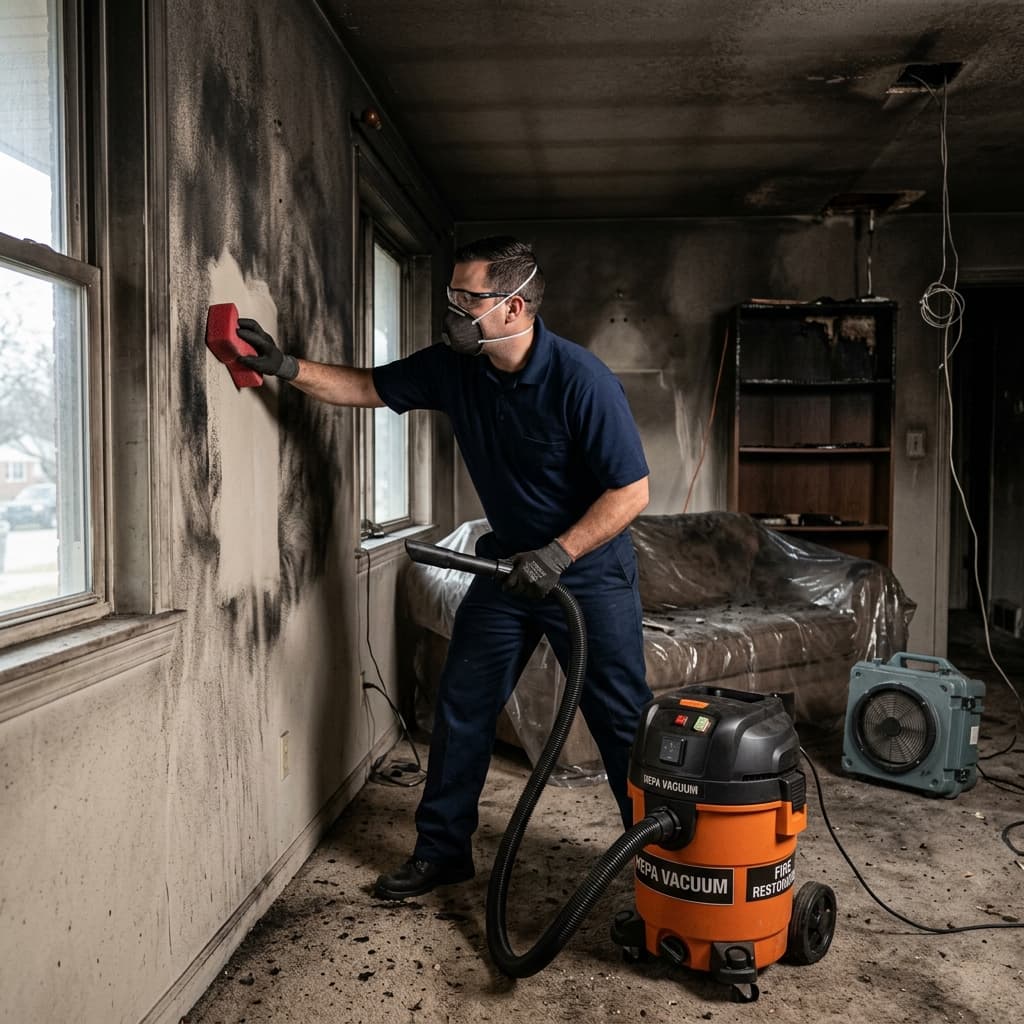
Fire damage mitigation keeps a fire loss from getting worse before fire damage restoration and repairs begin. The first phase can include securing openings, keeping soot from being spread, starting odor control, and removing water the fire department put into the building. Reconstruction of burned framing and finishes is a later scope.
At Prime Solutions LLC, we understand the stress that comes with property damage. Our restoration specialists are trained to handle Fire Damage Mitigation with care, documentation, and practical recovery planning for your home or business.
Fire damage restoration is the full recovery: soot and residue cleaning, odor treatment, contents decisions, and the repairs that rebuild damaged rooms. Fire damage mitigation is the stabilizing work that should happen first. It secures the building, limits secondary damage, and records conditions. A kitchen fire that is out can still leave an open roof, acidic soot on metal and glass, smoke in rooms down the hall, and gallons of water in insulation. Those problems do not wait for a rebuild estimate. Prime Solutions LLC separates that first phase from the later restoration scope so each part can be documented on its own.
After the fire department or the property authority releases the scene, openings may need to be closed. Broken windows, a damaged door, or a roof opening can let in rain, animals, and unauthorized entry. Board-up and tarping are mitigation, not a finished exterior repair. The goal is to protect the interior until a repair scope is written. Do not re-enter to inspect an unsafe roof or a sagging ceiling. If the structure is not cleared, mitigation waits.
Soot can be acidic and can stain or etch surfaces if it is wiped with the wrong cloth or household cleaner. Mitigation at this stage is about stopping the spread, not pretending the house is clean. That can include limiting traffic through sooty rooms, covering unaffected contents, and keeping the HVAC off when smoke or soot may be in the system. HEPA filtration may be used while debris is handled so particles are not blown through the house. A full cleaning method is chosen later, during restoration, based on the residue and the material. Air fresheners do not remove a smoke source.
Smoke odor clings to porous materials such as drywall, insulation, carpet, and upholstery. The mitigation phase identifies likely odor sources and keeps them from being sealed into a room. Odor control can include removing debris that is holding odor, ventilating only when that will not spread soot, and planning professional deodorization. Thermal fogging, hydroxyl generators, or other methods are restoration tools used when the source and the occupancy of the house make them appropriate. No method is promised to remove every odor on the first day. If odor remains in a wall cavity or in the HVAC path, the restoration scope has to say so.
Suppression water is part of many fire losses. It soaks drywall, insulation, flooring, and contents that the flames never reached. Mitigation treats that water as its own drying problem inside the same event: extract standing water, check moisture in walls and floors, and run drying equipment until readings support the next decision. Leaving firefighting water in place because the visible issue is soot is how a fire loss also becomes a mold concern. The water category still matters. Water that mixed with debris and combustion residue is not assumed to be clean supply water.
Accidental fire and smoke are commonly listed perils on homeowners policies, and the Insurance Information Institute includes fire or lightning on standard policy forms. Water used to extinguish a fire is often documented with that same event, but the policy, the deductible, and any exclusions still control the file. Prime Solutions LLC can separate board-up, soot stabilization, odor sources, suppression-water drying, contents, and later repairs in the notes an adjuster asks for. That documentation does not guarantee payment or a timeline. Confirm the claim with your carrier. Virginia consumers can also use the State Corporation Commission Bureau of Insurance if they need help understanding a policy question.
Call (703) 832-2773 after the property is released if the building is open to weather, if soot or smoke residue is on surfaces, if odor is noticeable beyond the burn room, or if firefighting water is inside. Have the address ready and say whether the power and gas are off. Prime Solutions LLC is based at 42785 Generation Dr, Ste 516, Ashburn, VA 20147, and serves Ashburn, Leesburg, Sterling, Purcellville, Reston, Herndon, Fairfax, Chantilly, Vienna, Arlington, and nearby Northern Virginia communities. Fire damage restoration is the next hub when the loss moves from stabilization into cleaning and repair.
Call after clearance if windows, doors, or the roof are open, if soot is visible, if smoke odor has moved past the burn area, or if hose water is on floors or in ceilings. Do not run the HVAC to clear the smell, and do not throw away contents before they are photographed. If you are unsure the building is safe, stay out and describe what the fire department told you.
Public references: IICRC S500, used as the drying reference for suppression water; Insurance Information Institute disaster-peril overview.
It includes the stabilizing steps after a fire is released: securing openings, documenting conditions, keeping soot and smoke from being spread, starting odor control, and drying water from firefighting. Full cleaning, contents decisions, and reconstruction are fire damage restoration and repair.
Only after the fire department or the authority in charge of the property allows entry. Unsafe roofs, sagging ceilings, and energized equipment are reasons to wait. Call (703) 832-2773 once you know the scene is released, or call earlier to plan access.
No. Soot can be acidic, and wiping it can set stains or push residue into finishes and into clean rooms. Photograph conditions and leave cleaning methods to the restoration scope.
Yes. Water used to put the fire out is documented and dried as part of mitigation. Insulation, drywall, and flooring can hold that water even in rooms that did not burn.
Fire losses are often eligible for review, and board-up is commonly part of protecting the property from further damage. Whether a specific line is paid depends on the policy and the carrier's review. Nothing on this page is a coverage promise.
Mitigation secures and stabilizes. Restoration cleans soot and odor, addresses contents, and connects to repairs. Many Ashburn fire losses need both, in that order. Use the fire damage restoration hub for the full recovery scope.
Fire Damage Mitigation is a standards-based restoration discipline — the work is planned, performed, and verified against industry reference documents (ANSI/IICRC S500 for water, S520 for mold, S540 for biohazard), and documented with photos, moisture readings, and dated scope notes. Prime Solutions LLC (Virginia DPOR License #2705191673, valid through February 2027) performs this work across Northern Virginia, Washington DC, and nearby Maryland.
| Question | DIY | Professional |
|---|---|---|
| Is the moisture really gone? | Surface feels dry; wall cavities unknown | Moisture meters and thermal imaging confirm hidden saturation |
| Will insurance accept the file? | Phone photos, no readings or dated scope | Timestamped photos, readings, scope notes, equipment logs |
| Contamination handling | Household cleaners on category 2–3 water or mold | Containment, HEPA filtration, documented disposal per S500/S520/S540 |
| When DIY is reasonable | Small clean-water spill caught immediately on hard surfaces | Anything that soaked drywall, flooring, or sat overnight |
Updated August 8, 2026 · Reviewed by Nicolae Zugrav, founder of Prime Solutions LLC · Independent references: EPA, IICRC, CDC, FEMA, Virginia DPOR, III